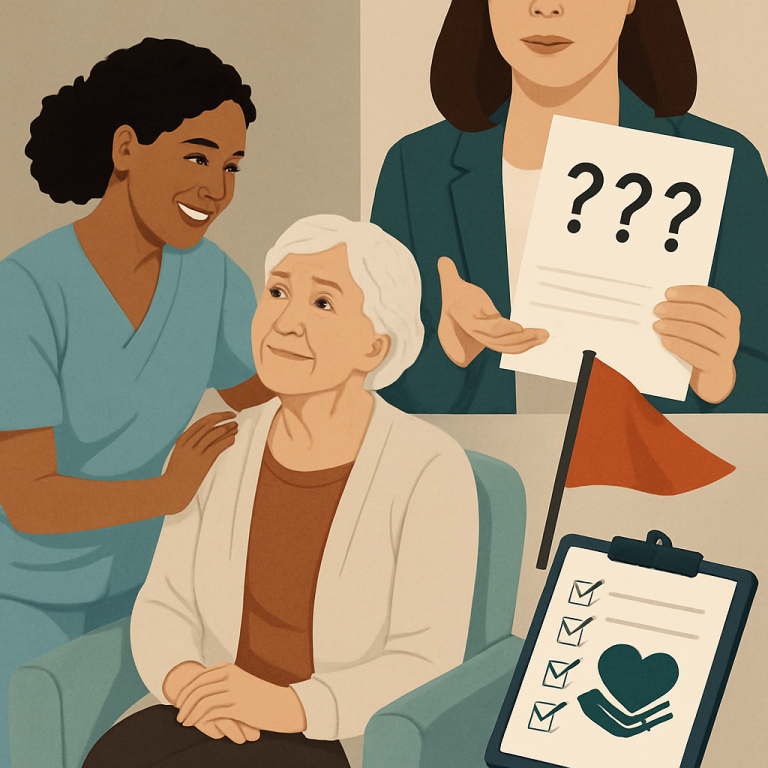

Home Care Assistance 101: Daily Living Support, Companionship, and Care Options
When a parent starts missing meals, falling more often, or comes home from hospital with new needs, families need clear options—not vague promises. This guide breaks down home care assistance – what services look like, who provides them, how personalized care plans and funding options work including Passport funding, and how to choose and manage reliable in-home support. You will get concise checklists, real-world examples for post-surgery and palliative care, and practical next steps to arrange safe support at home.
1. When to consider home care assistance and initial assessment
Start before a crisis. Families who wait for a fall or repeat hospital visit pay more in stress, rushed decisions, and higher short term costs. A timely home care assessment converts vague worries into a defined care plan with measurable goals and a realistic hours estimate.
Common, practical triggers for an assessment
- New losses in mobility. Difficulty rising from a chair, climbing stairs, or needing help with transfers.
- Daily living gaps. Missed meals, trouble with bathing or dressing, or skipped medications.
- Clinical red flags. Recent surgery, new wounds, frequent urinary infections, or weight loss.
- Caregiver strain. Family members are exhausted, unavailable, or reporting they can no longer provide safe assistance.
What an initial professional assessment actually covers. Expect a review of Activities of Daily Living and instrumental tasks, a medication reconciliation, a focused cognitive check, a brief falls and home safety survey, and a conversation about client goals – for example, returning to independent transfers or prioritizing comfort at end of life.
The intake workflow – what happens and why it matters
- Preliminary call. Triage questions that determine whether a PSW, RPN, or RN is needed first.
- In-home visit. Functional observation, medication review, and a quick environmental scan for fall hazards.
- Care plan draft. A recommended schedule, safety interventions, and measurable short term goals.
- Agreement and scheduling. Client signs a service agreement and first visits are booked; clinical tasks are assigned to licensed staff.
Tradeoff to accept up front. Higher intensity or 24 hour support reduces acute risk but increases cost and can erode family caregiving capacity faster than planned. A pragmatic compromise is a time limited trial – for example daily morning care plus check ins – then reassess in two weeks and adjust hours or tasks.
Concrete example: A 72 year old returning home after hip surgery received twice daily PSW visits for transfers and dressing during week one, RN wound checks three times that week, and evening companion visits to reduce nighttime confusion. Within 10 days the RN passed medication teaching to family, mobility progressed, and the schedule was reduced to single daily support with targeted physiotherapy coordination.
Practical judgment: Do not wait for a single catastrophic event to trigger services. Early assessment reveals small, fixable issues – poor lighting, medication timing, or a missing grab bar – that prevent bigger problems and cost less than emergency care.

Next consideration – if the assessment recommends skilled nursing tasks or frequent visits, ask about RN oversight, documentation cadence, and a reassessment date. Those operational details determine whether the plan will keep the person safe and avoid unnecessary hospital returns.
2. Core types of home care services and what they include
Key point: Home care assistance is not one service but a set of distinct offerings that address very different needs. Choosing the wrong type wastes money and increases risk. Match the service to the immediate goal – safety, recovery, symptom control, or social support – then layer services as needs change.
Personal care and daily living support
Personal care: practical help with Activities of Daily Living provided by Personal Support Workers or trained caregivers. This is where most families start when eating, bathing, dressing, toileting, or transfers become unsafe.
- Assistance with bathing, dressing, grooming, and toileting
- Mobility help and safe transfers including use of lift equipment
- Meal preparation, basic feeding support, and light grocery shopping
- Simple medication reminders and daily check ins
Skilled nursing and clinical services
Skilled care: delivered by Registered Nurses RN or Registered Practical Nurses RPN for clinical tasks that require training and clinical judgment. These services reduce readmission risk but require clinical oversight and scheduling lead time.
- Wound and ostomy care, complex dressing changes, and IV therapies when ordered
- Medication administration including injections and monitoring for side effects
- Clinical assessments, care coordination with physicians, and education for family members
- Monitoring of chronic conditions and early escalation when status changes
Rehabilitation, post-surgery, and private duty nursing
Recovery focused care: short term, goal oriented support that pairs PSWs with therapists and RN oversight. This reduces length of stay and speeds functional gains but is task intensive and costlier than basic personal care.
Concrete example: A 68 year old returning from coronary bypass receives daily RN visits for medication titration and incision checks, plus twice daily PSW visits to assist with walking, stair practice, and meal prep. After two weeks of targeted rehab and family teaching the RN reduces clinical visits and the PSW schedule shifts to maintenance and transportation to follow up appointments.
Palliative care at home
Comfort and symptom control: interdisciplinary teams focus on pain management, breathlessness control, emotional support, and caregiver coaching. This is clinically driven but must balance aggressive symptom control with clear goals of care set by the family and physician.
Companionship, homemaking, and respite care
Social supports: companion care and homemaking preserve quality of life and prevent isolation. These services provide transportation, structured activities, light housekeeping, and planned respite for family members, but they are not substitutes for clinical monitoring.
Verify who provides RN oversight, how visit notes are recorded, and the escalation pathway before signing an agreement. Many families assume clinical oversight is included; that assumption is often incorrect and has real consequences.
3. Who provides care and what each role does
Straight answer: home care assistance is staffed by workers with clearly different legal scopes, training, and practical limits. The choice matters because the wrong mix increases risk or wastes money.
Core roles and practical boundaries
Registered Nurse (RN): Clinical leader who performs complex assessments, develops clinical orders, manages wounds and IV therapies, and coordinates with physicians. RNs set care goals and handle medication teaching. They should be your escalation point for clinical change.
Registered Practical Nurse (RPN): Provides routine clinical tasks and monitoring within a regulated scope. RPNs handle injections, basic wound care, and stable medication administration but escalate to an RN for complex or rapidly changing conditions.
Personal Support Worker (PSW): Delivers daily living assistance such as transfers, bathing, toileting, meal support, and mobility help. PSWs are the hands on presence most families see; they do not perform regulated nursing procedures like IV therapy or complex medication administration.
Trained caregiver / companion: Focuses on homemaking, transportation, social engagement, and respite. Useful to maintain quality of life but not a replacement for clinical monitoring.
Private duty nurse and live in caregiver services: Private duty nurses provide continuous clinical coverage when needed; live in arrangements can reduce hourly cost but create scheduling and labour law tradeoffs and often require careful back up planning.
| Role | Typical tasks | Supervision or regulation | When to choose |
|---|---|---|---|
| RN | Complex assessments, wound care, medication teaching, care coordination | College of Nurses oversight; clinical accountability | When needs are medical, unstable, or require physician liaison |
| RPN | Routine clinical tasks, injections, monitoring | Regulated nursing practice with defined scope | For stable clinical needs that still require nursing skills |
| PSW | ADLs, transfers, meal prep, mobility assistance | Agency training standards; not a regulated health profession | When daily living tasks and safe mobility are primary concerns |
| Companion / Trained caregiver | Social visits, errands, light housekeeping, transport | Agency or private hire; vary widely in training | To reduce isolation, provide respite, or handle nonclinical work |
| Private duty nurse / Live in | 24 hour clinical coverage or continuous supervision | Must comply with labour rules and clinical standards | When round the clock clinical needs exist and agency back up is required |
Practical insight: agencies offer backfill, supervision, and documentation that private hires often do not. That overhead costs more but prevents gaps when a caregiver is sick or on vacation. If budget is tight, plan a formal substitution policy and emergency contacts.
Concrete example: An older adult with moderate dementia and a pressure risk had twice daily PSW visits for ADLs, weekly RN skin checks, and evening companion visits to reduce sundowning. The RN adjusted turning schedules after two assessments and the PSW team was retrained on mattress rotation, preventing readmission.
Verify who signs clinical orders, who documents visits, and the escalation pathway before care starts. Assumptions about oversight are the single most common operational failure.
Final consideration: match skill to the problem and plan for continuity. Clinical needs require regulated staff and formal oversight; social and homemaking needs can be met by trained caregivers. Mix roles deliberately rather than relying on a single caregiver to cover every gap.
4. How personalized care planning works in practice
Personalized care planning turns an assessment into a usable plan with named responsibilities, measurable goals, and built-in checks — not a vague promise on a piece of paper. In practice this means deciding who does what, when, and how you will know if the plan is working.
A five-stage practical framework
- Stage 1 — Rapid clinical and functional synthesis: combine the RN/RPN clinical review with a PSW observation of ADLs and a quick home safety snapshot to identify immediate risks and time-sensitive tasks.
- Stage 2 — Priority goals and time horizons: set 1–3 clear goals (for example: independent transfers within six weeks, stable wound healing in ten days, or symptom control for palliative comfort) and a review date tied to those milestones.
- Stage 3 — Role and schedule mapping: assign regulated tasks to RNs/RPNs and ADL tasks to PSWs/companions, build a predictable visit schedule, and name the backup procedure if a caregiver is unavailable.
- Stage 4 — Risk controls and training: record fall-precaution steps, medication management rules, device use (eg. lifts), and schedule family training sessions so informal caregivers are competent with critical tasks.
- Stage 5 — Measure, escalate, revise: use visit notes and two simple measures (status of primary goal; any safety incident) to trigger an RN reassessment or schedule change at the agreed review date.
Practical tradeoff: highly granular personalization improves fit but makes scheduling and continuity harder. In my experience, effective plans use a stable core (fixed visit windows and consistent caregivers) plus a short menu of optional tasks that rotate in when needed. That keeps the plan realistic for agencies and predictable for families.
Concrete example: After a total knee replacement a client received RN visits on days 1, 3, and 7 for wound checks and medication reconciliation, daily morning PSW visits for transfers and exercise help for two weeks, and twice-weekly physiotherapy coordination. At the two-week review the RN confirmed safe wound healing and the PSW schedule dropped to three times weekly while community physiotherapy continued.
Families often misunderstand two things: first, a care plan is a living document and should change when goals are met or when risks appear; second, not all workers can perform clinical tasks — in-home care assistance requires RN oversight for regulated procedures. Ask explicitly who will sign clinical orders and where visit notes are stored.
Decide the review cadence up front. If there is no reassessment date, expect scope creep and unnecessary cost.

5. Funding and payment options including Passport assistance
Practical bottom line: paying for home care assistance is a mix of tradeoffs: private pay buys speed and choice; public programs buy affordability but add paperwork, eligibility rules, and service restrictions.
Common payment routes and what they actually buy
- Private pay: fastest to start, fully flexible scheduling, and easiest to use for short-term needs like post-surgery. Expect to pay more per hour and to cover backfill costs when staff change.
- Provincial and federal programs: vary by province; in Ontario you may access targeted funds or Home and Community Care supports through your Local Health Integration entity. These reduce out‑of‑pocket cost but often require clinical eligibility and predefined service types.
- Passport funding (Ontario): meant for community living supports for eligible adults with developmental disabilities and can cover some in‑home supports when aligned with the individual plan.
- Veterans Affairs and specialty insurance: may cover certain skilled nursing or private duty nursing costs if eligibility criteria are met.
- Hybrid approaches: families commonly mix funding sources—use program dollars for core supports and private pay for extra hours, companion visits, or specialized services.
Key tradeoff to accept: program dollars usually come with a service specification and audit trail. That keeps costs down but reduces the ability to change caregivers or add ad hoc hours quickly. If immediate coverage matters, budget for short-term private pay while funding is sorted.
Navigating Passport funding in Ontario — practical steps
- Confirm applicability: Passport supports adults with developmental disabilities for community living needs. Do not assume it covers age-related care needs alone; confirm eligibility at the local Passport office or on the Ontario Passport page.
- Assemble the care justification: a brief, goal-focused care plan that explains the supports requested, how they enable community living, and any clinical notes that support the request.
- Choose a management model: decide if the funding will be agency-managed or family/participant-directed; this affects invoicing, hiring, and accountability.
- Submit with documentation: include ID, assessments, care plan, and any supporting clinical notes. Keep copies and log submission dates.
- Plan interim coverage: typical processing can take several weeks; arrange private-pay support or reduced schedules until approval and allocation are finalized.
Concrete example: An Ontario family applied for Passport to fund extra companion visits and transportation for a 45 year old with intellectual disability transitioning from group home to an apartment. They worked with Cedar Home Health Care to create a focused support plan, submitted clinical notes and a budget, and used private-pay companion hours for six weeks while the application was processed.
Cost comparison example: typical private‑pay ranges in many Ontario markets are approximately PSW-level personal care at $25–40/hour and RN visits at $50–90/hour depending on complexity and after-hours premiums. Passport or program funding may cover equivalent services at a lower out-of-pocket cost but will allocate hours against an approved budget rather than pay open‑ended hourly bills.
Judgment call most families miss: do not wait for approval to address immediate safety risks. Use short-term private pay or an agency rapid-start package, then convert to funded supports once the Passport or other program is in place. Agencies that assist with applications reduce errors and speed approvals; that assistance is worth paying for if it shortens the interim private-pay period.
Next consideration: if speed matters, lock in a minimal private-pay schedule to manage risk now and treat public funding as the route to long-term affordability—not as a short-term substitute for immediate safety.
6. How to choose a home care provider and key questions to ask
Make selection decisions on operational terms, not marketing. A glossy brochure means nothing if the provider cannot replace a sick caregiver in 24 hours, does not document clinical visits, or has no RN available for escalation. Prioritize things you will live with weekly: staffing continuity, clinical oversight, clear pricing, and an explicit substitution policy.
What matters in practice
Core checks to do fast. Confirm the provider runs police record checks and liability insurance, requires ongoing training for staff, and publishes an RN supervision model. Ask where visit notes are stored and how families receive incident reports. Those operational details are where service quality actually appears or fails.
Tradeoff to accept. Cheaper hourly rates often mean higher turnover and weaker backfill. If continuity matters more than cost for your case – dementia, palliative care, or complex wound management – pay for a stable team or an agency that guarantees core caregivers rather than the cheapest hourly option.
Top questions to ask on first contact
- Response times: How quickly can you start care and what is your emergency response window outside scheduled visits
- Clinical oversight: Which regulated nurse signs clinical orders and how often does an RN review the plan
- Substitution policy: What happens if a scheduled caregiver is sick or late and how is the family notified
- Documentation: How are visit notes recorded, where can family view them, and how soon after a visit are they available
- Training standards: What mandatory training do caregivers complete and how often is refresher training provided
- Infection control: What protocols do you use, and how do you handle outbreaks or clients with infectious conditions
- Insurance and liability: Do you carry professional liability and commercial general liability and can you provide certificates
- Background checks: Do you perform police record checks and reference checks for every hire
- Scope and limits: Which tasks your staff will not perform and how you escalate clinical tasks to an RN or physician
- Scheduling flexibility: Can hours change week to week, and what notice is required to amend the schedule
- Billing transparency: How are overtime, holiday, and cancellation fees calculated and shown on invoices
- References: Can you provide local client references for similar care needs and a recent example of a care plan you executed
Real-world example: A daughter arranging post-surgery care insisted on three checks: RN availability within 24 hours, a named primary PSW plus one backup, and daily visit notes emailed to the family. The chosen agency met those terms, started care in 48 hours, and the named RN adjusted medication instructions on day three after a clear visit note flagged an adverse reaction.
A judgement most families miss: Vendor selection is not final. Insist on a short trial period with measurable goals and a named reassessment date. Providers who resist a two-week trial or refuse to write measurable goals are often selling schedule flexibility at the expense of accountability.
7. Daily management, safety, and quality of life strategies at home
Clear reality: outcomes for most people receiving home care assistance are decided by small, repeatable routines rather than dramatic interventions. Daily systems for medication, mobility, sleep, hydration, and social contact prevent most hospital returns and preserve dignity. Families who treat these as operational problems get better results than those who treat them as occasional errands.
Medication, clinical checks, and realistic automation
Medication management: use technology to reduce human error but do not outsource clinical judgment. Automated dispensers and reminder apps like MedMinder reduce missed doses; however a weekly RN reconciliation is still necessary when regimens change or when multiple prescribers are involved. Tradeoff: automation reduces routine errors but can hide adherence problems caused by side effects or swallowing difficulty.
- Daily and weekly checklist: morning safety visual check, confirm scheduled medications taken, supervised meal with swallowing precautions if required, hydrate reminder, footwear review, and a quick walk or exercise session.
- Weekly clinical review: RN or RPN review of medication list, wound or symptom check, and a brief note sent to the family with one action item.
- Social contact plan: at least three meaningful interactions per week beyond task oriented visits – phone, video, or in person companion care – to reduce isolation.
Practical limitation: technology and devices are not substitutes for consistent caregiver presence. Motion sensors and emergency pendants help, but false alarms and missed charging cycles create new failure modes. Expect monitoring tools to require periodic maintenance, batteries, and a named person responsible for checks.
Fall prevention and environment – balance cost and human factors
Focus on the path people travel. Most falls happen during routine trips to bathroom or kitchen. Low cost fixes like improved lighting, removing loose rugs, and adding stable bedside lighting yield more reduction in falls than expensive equipment if you do not pair the equipment with behavior changes and caregiver routines.
Tradeoff to consider: 24 hour monitoring or live in caregiver services reduce risk but increase cost and can erode family involvement. Sensor mats and bed alarms reduce overnight falls risk but raise caregiver workload because of false positives. Choose layered controls: environment first, scheduled checks second, monitoring third.
Concrete example: A 78 year old stroke survivor required timed meals because of a swallowing safety plan and became withdrawn after discharge. The family put a simple routine in place: morning PSW supervised breakfast, midday video call with a volunteer companion, and evening RN check twice weekly for swallowing progress. A MedMinder dispenser reduced missed meds, and the RN adjusted textures after one week, avoiding aspiration and rehospitalization.
High impact, low cost first steps: clear night light pathways, a single chair near the toilet for rest, non skid footwear, a visible medication list, and one predictable daily social contact.
Final consideration: start with a short, measurable trial for any new routine or device and name who will own checks and escalation. If no one is responsible for weekly RN review, monitoring will fail and costs will rise without improved safety.