
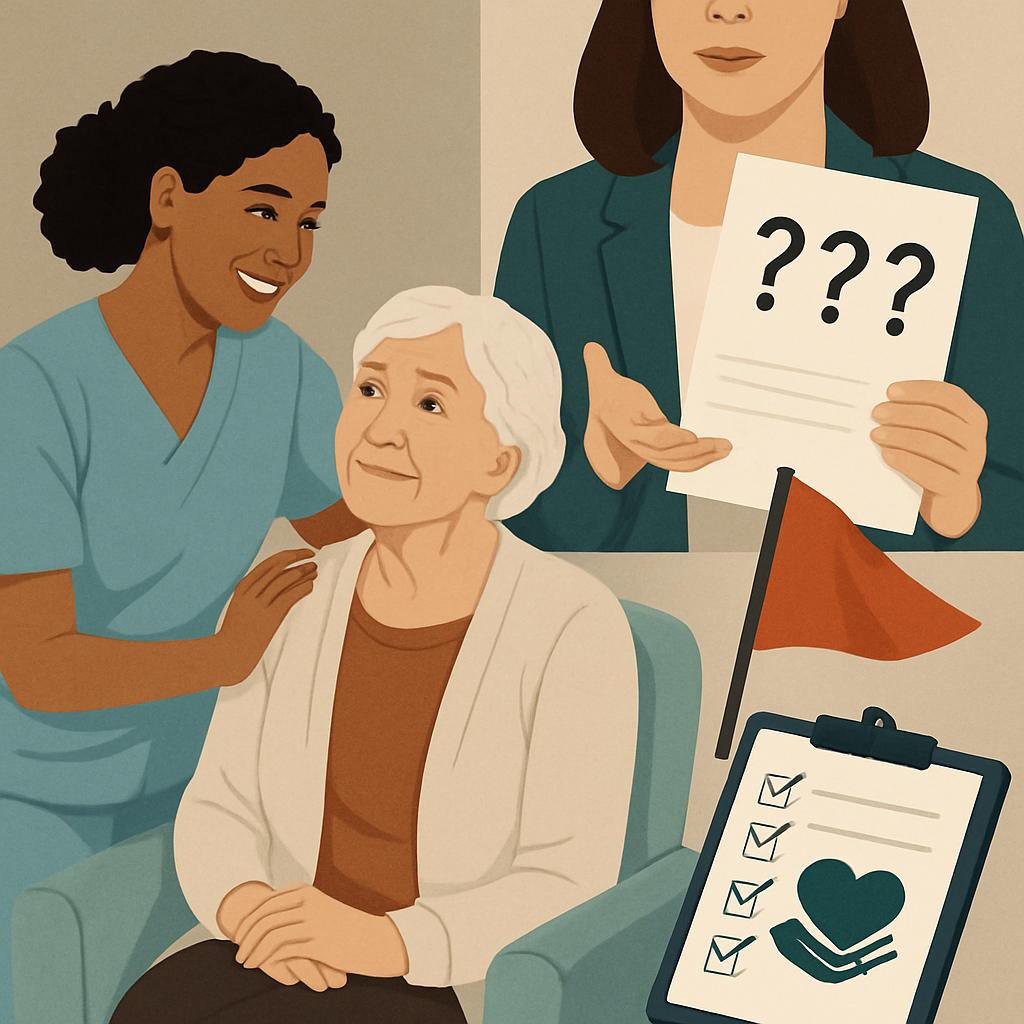
Hiring a Home Aide: Interview Questions, Red Flags, and How to Ensure Compassionate Care
Hiring a home aide is a practical and emotional decision that directly affects safety, dignity, and daily life for your loved one. This guide gives family members and decision makers a step-by-step playbook – interview questions that reveal competence and compassion, concrete verification steps, red flags to act on, a trial-shift checklist, and tips for long-term oversight and funding. Read on to learn what to ask, what to document, and how to build compassionate, reliable in-home care.
1. Clarify care needs and scope before you start hiring
Start by writing a clear job of exactly what the home aide must do each shift. Families who begin hiring with a vague list end up managing scope creep, missed tasks, and personality mismatches. A precise task list protects safety and makes interviews and trial shifts far more useful.
Practical trade off: estimate hours conservatively. Underbooking support to save money usually creates risk – missed meds, falls, or caregiver burnout. Overbooking creates extra cost but buys flexibility for breaks, hospital follow ups, or unplanned care when the client has a bad day.
Quick needs assessment to record before you recruit
- Primary tasks: List ADLs to be assisted – bathing, dressing, toileting, grooming
- Medication: Number of medications, who administers, whether precise timing or injections are required
- Mobility: Transfer level – independent, supervision, one person assist, two person assist, use of hoist
- Wound or skilled needs: Presence of dressings, drainage, or RN led tasks that need coordination
- Cognition and behaviour: Level of orientation, wandering risk, triggers to avoid
- Schedule and hours: Exact start and end times, days per week, expected overtime or sleepover needs
- Companionship: Meal prompting, conversation, community outings or only in-home presence
- Transportation needs: Escort to appointments or errands and vehicle insurance expectations
- Documentation: Required daily notes format for family or RN review and preferred communication method
- Contingency plan: Backup coverage preference and how emergency contact should be reached
Concrete example: A client discharged after hip repair needed two person transfers for the first two weeks, medication reminders three times daily, and light meal prep. The family documented those tasks, then recruited a home aide with experience in post surgery mobilization and scheduled RN visits for wound checks.
What many families miss: non clinical needs like timing of visits around preferred routines and cultural or dietary preferences are as important as clinical tasks. A technically competent home aide who clashes with daily rituals will cause breakdown faster than a less experienced aide who fits routines.
Record the assessment in writing and attach it to job ads, interview guides, and trial shift checklists to keep everyone accountable.

2. Essential qualifications and verification steps
Start with non-negotiables: insist on a vulnerable sector police check, two verified references, proof of core training, and a documented trial shift before you trust a home aide with unsupervised care. These items are minimum risk controls — not guarantees.
Who should do what: credential realities and limits
Understand scopes and trade-offs. An RN or RPN does assessments, medication administration by injection, and sterile wound care; a PSW or personal support worker handles ADLs, mobility assistance, meal prep, and companionship. Do not ask PSW-level candidates to perform regulated nursing tasks. Where a client needs both nursing and personal care, expect an RN-led care plan plus PSW execution under supervision.
Practical limitation: certifications can be forged or out of date. Calling the issuing college or training school and asking for a completion date and course code is cheap and effective. Equally important: a supervised competency demo during the trial shift tells you whether classroom skills translate to safe practice.
- Verification steps — step-by-step: obtain a vulnerable sector police check and verify identity against government ID
- Check training: request original certificates for PSW courses, CPR/First Aid, and dementia training; call the issuer to confirm
- Immunization and TB: review immunization record and any TB screening if the client has respiratory vulnerability
- Reference checks: speak to two former employers with scripted questions (sample below) and verify employment dates
- Competency demo: require a supervised trial shift showing transfers, documentation, medication prompting, and infection control
- Insurance and work status: confirm WSIB or equivalent coverage if hiring privately, or confirm agency liability insurance if using an agency
Sample reference check questions
- Can you confirm employment dates and role responsibilities? Listen for precise examples, not vague praise.
- Describe a time they handled a medication or mobility error. Strong answers show corrective action and communication with family or RN.
- How did they handle difficult family dynamics or emotional clients? Look for empathy plus boundary setting.
- Would you rehire them today? Why or why not? A hesitant or non-specific yes is a red flag.
Concrete example: a family hired a home aide with a PSW certificate shown by photo. The family called the college and discovered the certificate number did not match any graduate record. They declined to proceed and instead arranged RN visits for the first week while re-recruiting, which prevented skill mismatch during post-op recovery.
3. Interview questions to evaluate clinical competence and compassionate fit
Directness matters: ask questions that force candidates to describe specific actions, not just values. Clinical answers show knowledge; behavioural answers show how they actually behave under stress. A candidate can memorize protocols — they cannot fake how they respond when a client resists care. Expect to corroborate answers with a supervised trial shift.
Clinical skills and medication safety
- Tell me about a time you caught a medication error. What did you do next?
- How do you document medication reminders you give and any missed doses?
- Describe how you prepare and offer oral medications to someone with swallowing difficulties.
- Which medications would you escalate to an RN immediately and why?
- Explain how you confirm a client identity before giving meds when two people have similar names.
- What steps do you take when a family reports a change after a med was given?
Transfers, mobility and safe handling
- Walk me through how you do a one-person stand-and-pivot transfer.
- When do you use a gait belt and where do you place it?
- Have you assisted with a mechanical lift? Describe your exact responsibilities.
- What do you do if a client begins to fall during a transfer?
Dementia and behavioural care
- Describe a technique you use to de-escalate agitation without physically restraining.
- How do you redirect someone who repeatedly attempts to leave the house?
- Give an example of how you support personal hygiene when a client resists bathing.
- What signals tell you a behaviour is new and needs clinical reassessment?
Communication, family collaboration and documentation
- How do you report small but important changes in condition to family or RN? Provide an example.
- Describe a time you handled conflicting instructions from family members.
- What belongs in a shift note and how long after a shift do you write it?
- How do you check and confirm the client preferences recorded in the care plan?
Problem solving and emergency response
- You arrive and the client is pale and dizzy. What do you do in the first five minutes?
- Describe how you would handle a choking event during a meal.
- Tell me about a time equipment failed (hoist, oxygen). What was your immediate step?
- How do you prioritize care when two scheduled tasks conflict with an urgent change in condition?
Values, compassion and fit
- Why did you choose home care work and what keeps you in it?
- Give an example of when you advocated for a client with a healthcare team or family.
- How do you learn a client’s life story quickly to make care more person centred?
- Describe a boundary you set to protect a client and yourself.
| Question | Strong answer | Red flag |
|---|---|---|
| Tell me about a time you caught a medication error. | Describes noticing wrong dose, stopped administration, informed RN/family, documented incident, and participated in a follow-up change to prevent recurrence. | Evasive answer or says they would tell someone without specifics; no documentation example. |
| Walk me through a one-person transfer. | Steps given in order: explain, lock brakes, position feet, use gait belt at waist, kneel to support, pivot toward strong side; names when to call for help. | Vague steps, incorrect gait-belt placement, or says they usually just help without safety checks. |
| How do you de-escalate agitation? | Names specific techniques: validate feelings, reduce stimuli, use short sentences, offer alternative activity, knows when to call RN or emergency. | Relies on physical control, ignores triggers, or says they use tough love to calm clients. |
| How do you document shift notes? | Explains timely notes with times, tasks completed, food/fluid, behaviour changes; uses agency form and flags RN for clinical changes. | Says notes are optional or ‘I’ll tell the family later’ and has no system for urgent flags. |
| Why home care work? | Talks about helping clients remain at home, gives an example of small kindness that improved quality of life, links motivation to professional boundaries. | Gives a transactional answer about hours or pay only; lacks concrete examples of empathetic acts. |
6-minute interview script (quick screening): 0:00–0:30 introductions and confirmation of ID; 0:30–2:00 clinical question (pick one from clinical skills) with follow ups; 2:00–3:30 mobility or dementia scenario; 3:30–4:30 communication/family question; 4:30–5:30 values/fit question; 5:30–6:00 candidate questions and next steps. Use follow-ups like What exactly did you say? Who did you notify?
Concrete example: When hiring for a client recovering from hip surgery who also has early dementia, we asked the candidate to role-play a resisted transfer and to describe how they would keep dignity while getting assistance. A candidate who named specific phrases to reassure the client, called for a two-person assist when safe limits were reached, and documented the interaction earned a supervised shift with RN observation.
Next consideration: after this interview round, plan a short supervised trial that focuses on the exact tasks you asked about. If answers are strong but performance is not, transparency and documented remediation should guide your decision.
4. Red flags to watch for before, during, and after hiring
Start with phase awareness. Risks look different before hire, during a trial shift, and once someone is working regular hours. Treat each stage with a different threshold for action: investigate and verify before hiring, supervise and correct during trial, and remove or report immediately for clear abuse or criminal behaviour after hiring.
- Before hire – documentary and behavioural warning signs: evasive answers about employment gaps, refusal to produce original training certificates, requests for cash-only payment without a receipt, or social media posts that reveal client details or unprofessional commentary.
- During trial – performance and boundary issues: repeated lateness, poor personal hygiene, inconsistent or missing shift notes, visible disrespect toward the client, unsafe transfer technique that family or RN must correct, or clear disregard for infection control.
- After hire – slow, subtle signals of harm or neglect: unexplained changes in the client such as weight loss, bruising, repeated missed medications, disappearance of small valuables, sudden schedule changes without notice, or a caregiver who isolates the client from family.
Red flag decision tree
- Observe and record. Note date, time, what you saw, who was present, and take photos if relevant; preserve original notes.
- Assess immediate safety. If the client is at risk now, remove the caregiver from the shift and arrange backup care immediately using agency or RN support.
- Escalate to clinicians. Contact the supervising RN for clinical concerns; request a nursing assessment for unexplained new injuries or functional decline.
- Suspend pending review. Pause the aide from unsupervised duties while you verify records, check references, and interview the aide with a witness present.
- Report when required. For suspected abuse, theft, or criminal acts, contact police and relevant regulatory bodies; for professional breaches report to the agency and licensing body if applicable.
- Decide and document. Terminate or reinstate with a written remediation plan. Keep all records for payroll, funding audits, and any official investigations.
Practical tradeoff: A zero tolerance approach eliminates risk but can leave gaps in coverage and increase cost. In practice, minor competence failures often respond faster to documented remediation and supervised retraining, while any sign of intentional harm or boundary violation requires immediate removal. Families should plan backup coverage precisely because safe decisions sometimes mean losing a caregiver on short notice.
Concrete example: A family noticed a home aide posting continuous photos of the client online with identifying details and emotional commentary. The family pulled the aide from duty, documented screenshots, contacted the agency and police, and arranged temporary RN visits. The agency found the aide had previously received warnings for boundary breaches; the aide was dismissed and the family recovered continuity with a vetted replacement through Cedar Home Health Care.
Judgment that matters: Families routinely normalize small boundary crossings because they are uncomfortable with conflict. That is the point where risk compounds. Insist on documentation and follow the decision tree the first time a concern surfaces. Doing so protects the client, preserves evidence, and keeps options open for remediation or formal reporting.
5. Trial shift and observation checklist
Start with the premise that a trial shift is not a courtesy — it is the primary safety test. Candidates can talk about technique; a timed observation shows whether they do it cleanly, calmly, and respectfully under real conditions. Use the trial to test technical skills, documentation habits, and interpersonal fit at the same time.
Timed 4-hour trial shift template (30 points)
| Time window | Focus and observable behaviour | Evaluator action | Points (0-5) |
|---|---|---|---|
| 0:00 – 0:15 | Arrival, ID check, introduction to client and family; punctuality and handoff clarity | Check ID, note arrival time, observe greeting tone and respect for privacy | 0-5 |
| 0:15 – 0:45 | Medication reminders and charting practice; safe offering and recording | Watch technique, ask candidate to demonstrate documentation, score timeliness | 0-5 |
| 0:45 – 1:45 | Assist with one ADL (bathing or dressing) focusing on consent, dignity, and technique | Observe step sequence, communication, client comfort, and glove/PPE use | 0-5 |
| 1:45 – 2:30 | Meal preparation and feeding or meal prompting; choking/safety posture | Assess hygiene, portioning, and safe assist with eating; note communication with client | 0-5 |
| 2:30 – 3:15 | Mobility and transfer practice (stand-pivot or sit-to-stand); use of assistive device | Watch positioning, gait-belt placement, call-for-help judgement, and pace | 0-5 |
| 3:15 – 4:00 | Environment, infection control, handover and documentation | Review written shift note, ask for verbal handover, score clarity and completeness | 0-5 |
Scoring guidance and trade-off: a total of 24 or more indicates a candidate who can proceed to supervised hires; 18 to 23 calls for targeted remediation and repeat trial; below 18 is a do not hire. Limitation: a single shift cannot predict reliability, long term judgment, or off-shift behaviour. Plan a week-one reassessment to verify punctuality and consistency.
- Key technical checks: watch gait-belt placement at waist level, neutral spine support, heel-to-toe foot positioning, and whether the candidate locks wheelchair brakes consistently.
- Infection control and PPE: note handwash duration, glove donning and removal sequence, surface wipe routines, and disposal of soiled items.
- Documentation habits: the note should include times, tasks completed, food/fluid intake, mood/behaviour changes, and any condition flags; expect legible entries made within 30 minutes of task completion.
- Person-centred behaviour: listen for the candidate using the client name, offering choices, asking permission before touch, and using short reassuring phrases for cognitively impaired clients.
Real-world example: During a 4-hour trial for a client after knee surgery, an applicant demonstrated correct stand-to-sit technique but repeatedly left shift notes illegible and delayed medication documentation. The family rejected an immediate hire, arranged supervised RN oversight for retraining, and accepted the candidate only after a successful second trial — preventing medication gaps and a possible fall.
- Evaluator notes template: Candidate name; date/time; total score; strengths observed; safety concerns; examples of wording used with client; decision (hire with supervision / retrain + re-trial / do not hire); required follow-up actions and who will supervise.
- Follow-up metric: require the aide to produce three consecutive shift notes reviewed by the RN within week one; if any note is late or unclear, pause unsupervised shifts until corrected.

6. Building and maintaining compassionate long term care
Compassionate long-term care is a system you build, not a quality you hope for. Put another way: the presence of a caring home aide will not alone sustain safety, dignity, and continuity unless you codify how care is delivered, supervised, and adjusted over time.
Important trade-off: consistency versus resilience. Assigning the same home aide improves rapport, reduces agitation, and makes person-centred adjustments easier to hit. It also creates a single point of failure if that aide becomes unavailable or burned out. Plan for both: a primary aide plus a half-dozen pre-vetted backups, and paid overlap time for handovers to keep knowledge transfer practical.
Three-month oversight plan with measurable checkpoints
Month 0 to 1 (onboarding and stabilization): document a short personalized care plan within 48 hours that lists three nameable rituals (mealtime preferences, religious practices, bedtime routine) and three clinical imperatives (med timing windows, transfer limits, wound check schedule). Require an RN check-in on day 3 and weekly 15-minute phone briefs with family during week one. Measure: shift notes submitted within 30 minutes at least 90% of the time; zero unreported missed medications; client-reported comfort score (1–5) logged daily.
Month 1 to 2 (consolidation and training): run a formal week-one review, then a documented re-competency session for any flagged skills (transfers, medication prompting, infection control). Introduce a caregiver wellbeing check every two weeks to spot early burnout. Measure: no more than one safety incident (near miss or error) per 30 days; caregiver retention indicator (no unscheduled departures).
Month 2 to 3 (review and adapt): hold a multidisciplinary care conference at week 8 and a fuller review at week 12 with RN, primary home aide, and family. Update the care plan, adjust hours or scope if needs changed, and schedule any refresher training. Measure: documented action items closed within 14 days; baseline health indicators (weight, skin status, mood) stable or improved versus intake.
- Sample monthly care conference agenda: Review clinical status and any new symptoms; review medication changes or concerns; discuss recent behavioural incidents and triggers; confirm personal preferences and rituals learned; evaluate caregiver workload and training needs; scheduling and backup coverage; funding or paperwork updates; assign actions with names and due dates.
Concrete example: A family caring for Mrs. K, who has moderate dementia and mobility limits, kept the same home aide for nine months. After three weeks the RN flagged rising agitation at evening care; a short retraining on bedtime rituals plus a small change in lighting cut agitation episodes by half. Because the family had pre-arranged backup coverage, the aide was able to take a planned respite day without disrupting continuity.
Practical insight: simple tools beat complexity. A one-page care snapshot pinned in the home and a shared digital log (photo or secure app) for shift notes will keep everyone honest. Do not rely on memory or informal text chains for changes in medication, escalation paths, or behavioural triggers.
7. Handling problems, replacement, and termination professionally
Start with safety, documentation, and a short remediation window. When a home aide fails expectations the priority is the client — secure immediate coverage, preserve evidence, and document what happened before you discuss corrective steps with the aide.
A practical, staged approach
Follow a clear, time-bound sequence so decisions are defensible and reversible when appropriate. This is about protecting the client while keeping options open.
- Secure continuity: arrange backup shifts now (agency, RN visits, or a pre-vetted substitute) so the client never goes without care during review.
- Record the incident: put dates, times, direct quotes, photos, and names into a single incident file. Use shift notes and any timestamps from devices or call logs.
- Interview with witness: meet with the aide with a supervising RN or family member present; let them respond, but stick to facts.
- Remediation plan: for non-criminal issues offer a written improvement plan with specific actions, measurable outcomes, and a firm deadline. Include supervised shifts and a named supervisor.
- Decision point: if the aide meets the plan, return to normal with monitoring; if not, proceed to termination and handover steps immediately.
Trade-off to weigh: remediation preserves workforce continuity and can repair isolated skill gaps, but it consumes supervision resources and carries risk if the aide is dishonest. Immediate termination removes risk quickly but creates coverage gaps and administrative work — plan your backup before you pull someone off shifts.
Real-world use case: A family found repeated late notes and two missed med reminders over a week. They paused unsupervised duties, required three supervised shifts with the RN present, and set a seven-day improvement window. The aide corrected documentation but failed punctuality standards and was replaced; the RN-managed overlap kept the client safe while knowledge transferred.
Practical protocols you must handle before and at termination: collect keys and access codes, retrieve or inventory client property, secure devices with client data, prepare a final payroll statement and receipt, and export the aide’s last seven days of shift notes for audits. Keep copies in the incident file for funding or legal review (for example Passport funding verification). Consult payroll or legal counsel for withholding and final-pay rules in your jurisdiction.
Do not rely on memory or text threads for final handovers. A short, signed handover record and receipt for returned items prevents disputes and preserves evidence for audits or investigations.
Sample termination notice (two-paragraph template you can adapt):
This letter confirms that, effective at close of business on [date], your assignment providing home aide services to [client name] is terminated for cause due to [brief factual reason: e.g., repeated missed medication reminders and failure to meet documentation standards]. This decision follows the supervised review meeting on [date] and the remedial period that ended on [date], during which required improvements were not achieved.
Please return all client keys, access codes, documentation, and any client property to [designated contact name and phone/email] by [time/date]. Your final pay, including hours worked through [last date], will be processed and delivered according to applicable employment rules; contact [payroll contact] for questions. If you have personal items at the client residence, coordinate a mutually agreeable pickup time with the supervising RN present. Failure to return client property may result in further action.
Final judgment: take action early and document everything. Families who delay or tolerate small breaches almost always compound risk. Use remediation where sensible, but have agency backup or RN-led interim care ready so termination does not become a crisis.
8. Legal, safety, and funding considerations families must check
Decide the employer role first. That single decision — family employer versus agency placement — determines payroll taxes, workers compensation, liability exposure, and who pays for mandatory benefits. Treat it like a clinical decision: pick the model that matches the level of clinical oversight and administrative capacity you can sustain.
Employment classification matters in practice. If you hire a home aide directly you are usually the employer of record: you must register for payroll, remit source deductions, comply with employment standards (hours, minimum wage, vacation pay), and carry workers compensation or equivalent. Using an agency shifts those obligations off your plate but adds agency fees and reduces direct control over scheduling and selection.
Insurance and liability you must verify. Ask for written proof of the aide or agency liability insurance and workers compensation coverage before the first paid shift. If the aide will transport the client, confirm vehicle insurance and a clean driving record. For clinical tasks, check that the agency or supervising RN has malpractice coverage or clinical liability policies in place.
Funding and documentation — what funders will want to see
Funding is auditable. Programs like Passport funding require precise records: signed timesheets, itemized invoices, clear task descriptions tied to the care plan, and copies of background checks and immunization proof. If you expect to use public or third-party funding, set up invoicing and a record-retention system before services begin — retroactive fixes are messy and often rejected in audits.
Trade-off to accept now: agencies simplify audit trails but cost more; private hires are cheaper per hour but demand administrative overhead and disciplined documentation to satisfy funders. Most families underestimate the time required to manage payroll, reimbursements, and audit requests — plan for at least two hours per week of admin work or outsource it.
- Checklist to confirm before first paid shift: signed job agreement specifying employer of record; proof of liability and workers compensation; completed vulnerable sector check consent; copies of training certificates and immunization record; a timesheet and invoicing template aligned with funding rules; documented escalation and emergency contact protocol; written consent for collecting health information for funding audits
Practical example: A family in Ontario used Passport funding to hire a private duty caregiver but failed to require signed daily timesheets. When the funding office audited three months later they denied two pay periods. The family recovered payment only after producing retroactive, signed acknowledgements from the aide and running a formal timesheet process through the rest of the claim — a painful delay avoided by a simple signed form at hire.
Judgment that matters: when care needs are simple and your household can reliably handle payroll and paperwork, private hire saves money. When needs are complex, involve regulated nursing tasks, or you cannot tolerate coverage gaps, choose an agency for RN oversight, faster backup, and clearer legal protections. If you plan to use Passport or similar supports, involve your funding caseworker early and keep records in a single, searchable folder.
Next consideration: before you sign anything, map who will manage payroll, who keeps the originals of background checks and immunizations, and where shift notes will be stored; the right administrative design prevents most legal and funding headaches down the road.
9. Resources and templates to download
Get these files before you start interviewing. Having the right templates ready turns hiring from guesswork into a set of repeatable checks — and that reduces the chance you end up with a poor fit or missed clinical steps when a home aide is alone with your loved one.
Available downloads and when to use each
- Needs Assessment Checklist — PDF. Use immediately to record ADLs, mobility level, medication timing, and personal preferences you will attach to job ads and interview packs.
- Verification Checklist — Excel. Step-by-step tracker for police check, immunizations, certificate verification, and reference calls; keeps documents auditable for funding reviews.
- 25-Question Interview Packet — DOCX/PDF. Print or share with interviewers; includes prompts and suggested follow-ups tailored for a home care assistant, PSW, or private duty caregiver.
- 30-Point Trial Shift Evaluation — Fillable PDF. Ready-to-use scoring form for a 4-hour trial shift; designed for RN or family evaluator to sign off on safety, documentation, and person-centred care.
- One-Page Personalized Care Plan Template — DOCX. A single-sheet snapshot for the home aide to carry: rituals, clinical imperatives, escalation contacts, and three measurable goals.
- Shift Note Template — CSV/XLSX. Minimal, funder-friendly format: time in/out, tasks completed, meds given/reminded, food/fluid, mood/changes; built for quick audit export.
- Remediation and Termination Template — DOCX/PDF. Formal improvement plan and short termination notice you can adapt; includes return-of-keys checklist and payroll reminders.
- Sample Timesheet + Invoice Pack — XLSX/PDF. Formatted to meet common Passport funding audit needs in Canada; includes signature lines and expense lines.
- Passport Funding Documentation Pack — PDF. Practical instructions, examples of accepted records, and a sample submission checklist for Canadian provincial Passport programs.
- Emergency Escalation Card — PNG/PDF. Printable fridge card listing immediate steps, RN contact, emergency meds, and nearest hospital directions — for fast reference.
Practical trade-off: Templates cut administrative time and standardize evidence for audits, but they can promote a checkbox mentality if used without adaptation. Customize each file for the client — especially the care plan and escalation steps — and keep the supervising RN in the loop so templates reflect clinical reality.
Concrete example: A family used the 30-point trial shift evaluation PDF and the One-Page Personalized Care Plan to hire a home aide for evening care. The form flagged poor medication documentation during the trial; the family required two supervised shifts with RN oversight before confirming the hire, preventing a missed-dose incident after discharge.
What most people misunderstand: downloadable packs are only as good as the workflow around them. File naming, version control, and a single storage location (cloud folder or agency portal) are the practical controls that stop documents from being lost or overwritten when multiple people contribute to care.
Next consideration: pick one person to own the folder and the review schedule. That single accountability decision is the difference between templates being used and templates becoming shelfware.