

Top Skills Required for Personal Support Workers
Employers hiring personal support workers in Ontario care about measurable, job-ready skills more than generic statements about being caring. This article breaks down the top skills tied to psw education, explains which parts of accredited programs teach them, and gives concrete resume language, practice exercises, and short training paths you can use to demonstrate competence on day one. Use this checklist to align your classroom and practicum experience with what home care agencies actually test for.
1. Clinical and Hands on Personal Care
Baseline expectation: employers treat competent delivery of ADLs as a pass/fail skill. PSW education programs teach bathing, grooming, dressing, toileting and basic bed care in labs and practicums, and hiring managers expect you to step into a client home and do those tasks safely, efficiently and with dignity.
How psw education maps to practice: accredited PSW programs such as those listed by the Ontario government and colleges like George Brown cover hands-on labs and supervised practicum hours where these tasks are practiced. Use your practicum evaluations and instructor references as concrete evidence of skill when applying.
Trade-off to manage: schools simulate ideal conditions; homes are not. Real-world constraints – cluttered spaces, family presence, client’s cognitive fluctuations – make routine care harder. Being fast is useful, but rushing reduces observation quality and can miss early skin breakdown or pain signals. Employers value balanced speed plus accurate observation more than pure speed.
Concrete example: a PSW on a morning shift for a client with moderate dementia adjusts the routine: allows the client to participate in choosing clothing, uses cueing rather than doing tasks for them, and notices a reddened area on the sacrum during bed-to-chair transfer. The worker documents the finding, cleans and repositions, and escalates to the RN with a clear description and photos when allowed – avoiding an avoidable pressure ulcer and preserving client dignity. Cedar Home Health Care emphasizes this mixture of practical care and early observation in its training resources: PSW education guide.
Practice checklist and resume language
- Quick checklist for bathing/grooming: Explain steps out loud, maintain privacy, check skin folds, document any redness or bruising.
- Pressure area spot check: Expose area briefly, note colour/temperature/skin break, reposition and offload for 10-15 minutes, record and escalate if persistent.
- Toileting assistance: Ensure safe footwear, use gait aid if needed, record continence pattern and any pain reported.
- Resume bullets: Assisted 6-8 clients per shift with ADLs – maintained 98% documentation accuracy; received practicum sign-off for bed-to-chair transfers from clinical instructor.
Practical judgment: list practicum hours and specific observed competencies on your resume rather than vague statements about caring. Employers in Ontario prefer documented, supervised evidence – a signed competency sheet for bathing or bed transfers holds more weight than a generic PSW diploma line.
Where to go next: if a program you are considering lacks extended practicum or observed competency sign-offs, compensate with short accredited refreshers or employer-run in-service training. The Ontario program overview explains minimum program expectations: Personal Support Worker Program – Ontario.
2. Safe Mobility and Transfer Techniques
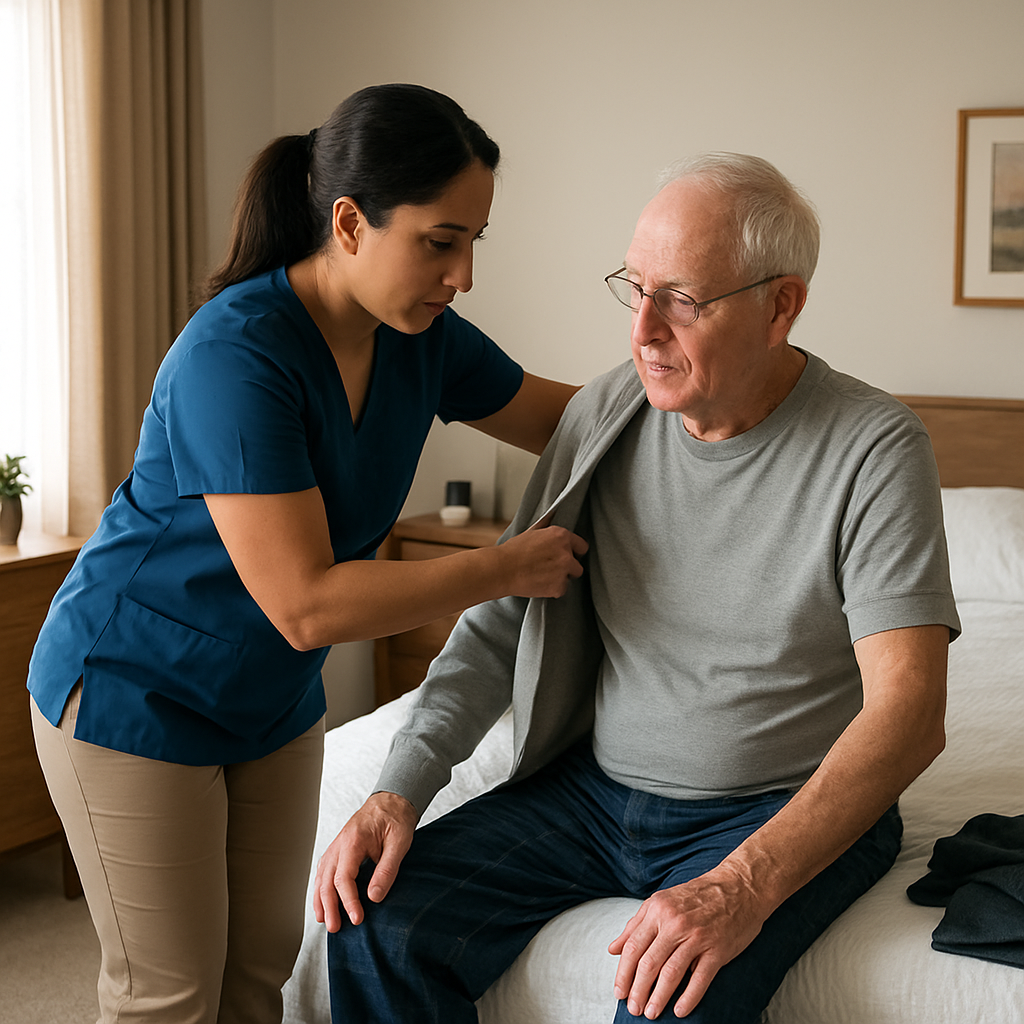
Immediate reality: Safe transfers and mobility support are the first competencies employers watch for on the job. Poor technique causes client injury, increases fall risk, and is the single biggest source of musculoskeletal injury for caregivers. Demonstrable transfer skills separate candidates with generic psw education from those ready for home care.
Where this appears in PSW education and certification
Education link: Accredited PSW programs teach transfer theory in labs and enforce practice hours during practicum; see examples in the Ontario PSW programs overview and program details like George Brown College. Include these keywords on applications: psw education, psw curriculum Canada, and psw certification Ontario when you list formal training and practicum.
- Core competencies to demonstrate: sit-to-stand transfers, lateral transfers to bed, pivot transfers, safe use of gait belts, fall recovery technique, and two-person assists.
- Mechanical lift skills: setup, sling selection, safe hooking, battery and brake checks – only after documented lift training and employer authorization.
- Assessment skills: interpreting transfer plan, recognizing weight-bearing restrictions, and escalating when a transfer is unsafe.
Tradeoff and limitation: Mechanical lifts reduce caregiver strain but are slower, require space and maintenance, and can undermine a client’s independence when overused. Gait belt and hands-on techniques support mobility but are unsafe for some post-op or high-weight transfers. Practical judgment matters more than rote technique; follow the transfer plan and seek RN sign-off when in doubt.
Concrete example: A postoperative hip replacement client is on partial weight bearing. A PSW used a gait belt and a pivot transfer under an RN-approved plan, observed a limp and new swelling, documented the finding, and escalated to the RN. That sequence – safe technique, observation, documentation, escalation – is how employers judge competence in home care and how Cedar Home Health Care expects handover to proceed: see Cedar PSW education resources for competency expectations: Understanding PSW Education.
Common misunderstanding: Many candidates list general transfer experience on resumes without evidence. Employers will ask for practicum sign-off or observed competency for specific techniques. Certificates for a one-hour lift course are useful but insufficient without supervised practice in a home environment.
How to show this on your resume and in interviews: Use concrete phrasing – Documented competency in sit-to-stand, two-person assist, and Hoyer lift operation; Practicum sign-off by RN; XX hours of supervised lift practice. During interviews offer a short sequence: approach, client cueing, belt placement, transfer mechanics, then documentation and escalation.
Key point: Employers hire for observed transfer competence, not just classroom completion. Arrange RN-observed sign-offs during practicum or orientation.
Takeaway: Get RN-observed sign-offs for each transfer technique you claim, record supervised hours from your practicum, and align your practice with employer transfer plans and safety policies.
3. Infection Prevention and Control
Infection prevention is a practical, everyday competency — not a checklist you do once. In home care the environment changes every visit, supplies are limited, and PSWs must translate institutional IPAC protocols into a private home without disrupting dignity or routines.
Key pragmatic point: focus on risk-based actions you can reliably repeat: hand hygiene, correct selection and disposal of PPE, cleaning shared equipment, and clear escalation when clinical signs suggest infection. These are the IPAC skills employers look for in psw education and on-the-job assessments.
Where psw education and refreshers fit
PSW programs cover IPAC in theory and practicum, but the difference-maker is repeated supervised practice. Look for psw training programs that include hands-on infection control drills during practicum hours — for example the modules listed in many accredited programs such as George Brown College. Use Cedar Home Health Care resources to map classroom IPAC to real home-visit routines: PSW Education Guide.
- Quick home-visit IPAC checklist: Perform hand hygiene on arrival and departure; choose PPE based on task and documented precautions; use disposable or client-dedicated equipment where possible; clean high-touch surfaces after care; document IPAC steps in the client note.
- Trade-off to manage: Overuse of PPE can alarm clients and families and reduce rapport. Explain purpose briefly and use lowest effective level of protection based on risk and care task.
- Documentation and escalation: Note symptoms (fever, new cough, wound drainage) and escalate to the supervising RN rather than assuming it is mild; timely reporting matters more than perfect initial judgment.
Concrete example: A client returns from hospital with recent C. difficile suspicion. The PSW implements contact precautions on the first visit: performs glove and gown use for direct care, dedicates a commode and thermometer, cleans surfaces with an approved sporicidal product, notifies the RN immediately, and records the interventions and family education in the care note. Those steps reduce household spread and give the RN a clear record for further orders.
Resume and interview framing: list specific IPAC components completed during training (for example: practicum audits, observed hand-hygiene compliance, course certificate), and give a concise outcome: reduced urinary catheter site infections during a practicum rotation, or led family education that improved PPE adherence. Employers prefer measurable, verifiable statements over vague claims.
IPAC in home care is about repeatable routines, risk communication, and clean documentation. Practical competence beats theoretical knowledge when you need to protect a vulnerable client.
4. Observation, Reporting and Documentation
Clear, timely notes save lives and careers. What you observe and how you record it is the primary clinical information RNs and physicians rely on in community care. Poor or vague documentation creates delays in treatment, exposes clients to harm, and increases legal risk for you and your employer.
What PSW education teaches and what practice demands
Practicum and documentation modules in accredited PSW programs introduce SOAP notes, objective observation techniques, and signature/timing standards. See the Ontario program overview at personal support worker program and our practical guide at PSW education guide for examples of curriculum components. In the field you will need to convert those classroom habits into fast, high-signal entries under time pressure.
- Quick checklist for an effective observation note: Timestamp and your initials
- Objective data first: vitals, intake volumes, measured wound size, pain rating on a numeric scale
- Change from baseline: concise comparison to yesterday or usual level
- Behaviour and function: mobility, orientation, feeding, toileting with exact details
- Action taken and who was notified: RN contact, family notified, emergency services called
Trade-off to manage: being exhaustive versus being useful. Overly long narrative buries critical signs. Use short, measured phrases that a clinician can scan. If you cannot capture everything, record the top three abnormal findings and the action you took.
Concrete example: A post operative client is less conversational at 09:15 and drank 100 mL overnight. Your note: 09:20 AB 72, BP 110/68, O2 95% on room air. Alertness decreased from baseline; oriented to person only. Oral intake 100 mL since 2200. Wound dressing dry, no drainage. RN called at 09:30; instructed to monitor every 30 minutes and report increased confusion. This short, factual sequence prompted an RN assessment and earlier medication review.
Common misunderstandings: New PSWs either underdocument by leaving out objective measures or overinterpret by writing diagnostic statements. Do not write clinical conclusions you are not licensed to make. Write what you saw, measured, and who you called.
Practice exercise: Take this verbal report and convert it to a usable note. Verbal report: client seemed off, less eating, sleeping more, looked pale. Improved note: 14:05 client less responsive than usual; slept through AM care; oral intake estimated 50 mL since 0600; skin pale, capillary refill 3 seconds; RN informed 14:20. Sign with initials. Repeat this exercise with a supervisor until they initial your entries.
Good documentation is concise, objective, time stamped, and action oriented. That combination makes your observations useful rather than burdensome.
5. Communication and Interpersonal Skills
Key point: Communication is not a nice-to-have polish on clinical work; it determines whether observations, care plans, and safety issues actually reach the right person on time.
Skill components: Effective PSW communication combines active listening, plain language explanations, teach-back, concise handovers, and respectful family collaboration. Employers value observable behaviours: calm de-escalation in distress, a one minute focused handover to an RN, or a teach-back that confirms understanding of mobility precautions.
Where psw education and training build this
Education mapping: Accredited PSW programs in Canada embed communication through role plays, client simulation labs and practicum feedback loops. See practical curriculum examples at George Brown College and the Ontario program overview at Ontario.ca. Cedar Home Health Care recommends documenting simulation performance and getting practicum supervisor signoff to prove competency.
Practical problem and solution: Family conflict often blocks safe care when preferences clash. Solution: use a short scripted negotiation that centres the client, clarifies non negotiables, and documents the outcome. If the family requests a task outside PSW scope, escalate immediately to the RN and record the conversation.
Concrete example: A PSW arrives for a morning visit where a family insists on early discharge routines that risk falls. The PSW uses a calm opening, explains mobility risks in plain language, asks the client to repeat back the plan, then contacts the supervisor for a care plan update. Cedar operationally supports this by providing escalation checklists and RN follow up within scheduled handover windows.
- Quick practice: Use three scripted opening lines for sensitive conversations: introduce yourself and the purpose, name one risk, and offer one safer alternative.
- Teach-back drill: After explaining a transfer or medication reminder, ask the client to describe the steps in their own words and note any gaps.
- Handover template: Practice a 30 to 60 second SBAR style handover to an RN: Situation, Background, Assessment, Request.
Trade off and limitation: Strong communication can compensate for limited experience but it cannot replace clinical competence. Employers will expect both a clear voice and observable practicum skills. Do not use polished language to obscure clinical gaps; instead pair communication examples with documented competencies earned in psw training programs or practicums.
What many candidates miss: Listing empathy on a resume is empty unless you attach measurable evidence. Employers in Ontario want concrete proof: practicum references, client satisfaction notes, documented conflict resolutions, or completion of specialized short courses in dementia or palliative communication. For resources and continuing education, consult HealthForceOntario and Cedar Home Health Care’s PSW education guide at Understanding PSW Education: What You Need to Know.
Practice scripted openings and a 60 second handover until they are automatic. That is how you turn soft skills into hireable proof.

6. Person Centered Care and Cultural Competence
Direct point: Person centered care is not a nicety, it is an operational requirement that changes what you do every shift. PSW education covers the theory, but the ability to translate a client history, cultural norms and language needs into a safe, usable care plan is learned on the job and through deliberate practice.
Education link: Accredited psw education programs and practicum components introduce ethics, diversity and communication modules, but employers should expect to supplement classroom learning with local cultural competence workshops and mentorship. See the Cedar PSW education guide for practical intake templates at Understanding PSW Education: What You Need to Know.
What matters in practice
- Preference over protocol when safe: Honor a clients routine and rituals if doing so does not compromise clinical safety or infection control.
- Documented accommodations: Write cultural preferences into the care plan so family members and other caregivers follow the same approach.
- Language and consent: If you do not share a language, escalate early to professional interpreters rather than guessing consent.
Trade off to know: Personalization takes time and creates variability in scheduling and task lists. In home care workflows that prize efficiency, PSWs must balance respect for preferences with measurable task completion and clear escalation when needs conflict with safety.
Concrete example: A client who observes a morning prayer routine prefers later bathing and a particular breakfast. The PSW adjusted wake and bathing times, documented the change in the electronic care plan, and flagged nutrition concerns to the RN. That single adaptation reduced client agitation and avoided unnecessary re-scheduling of RN visits.
Common misunderstanding: Cultural competence is not just language fluency or food choices. Employers and new PSWs often reduce it to surface gestures. The real skill is anticipating how culture affects mobility, pain expression, consent and family decision making, then recording workable interventions in the care plan.
Quick, practical steps for PSWs
- Use a three line intake checklist: preferred language, religious or dietary practices, and acceptable approaches to personal care.
- Convert preferences into tasks: note timing, gender preference for caregiver if requested, and any ritual items to leave in place.
- Document and escalate: add the notes to the client record and inform the RN when a cultural need intersects with clinical risk.
- Seek targeted refreshers: take short courses in dementia cultural approaches or palliative cultural practices beyond initial psw training.
Include one measurable accommodation per client record so person centered care becomes auditable and repeatable.
7. Professionalism, Ethics and Legal Awareness
Key point: Professionalism and legal awareness are not soft extras; they are core risk controls in home care. Employers assess a PSW on how they handle consent, confidentiality, boundaries, and requests that fall outside PSW scope rather than on empathy alone.
What psw education actually teaches and where it falls short
Education mapping: Accredited PSW programs cover ethics modules, case studies, and practicum conversations about consent and mandatory reporting. See the Ontario overview of PSW programs for curriculum expectations at Ontario PSW programs and workforce competency framing at HealthForceOntario.
Practical limitation: Classroom scenarios cannot reproduce every boundary or legal complexity that arises in a home visit. New PSWs often enter the field confident in technical care but underprepared for nuanced decisions where client preference, family pressure, and safety collide. Expect on the job mentoring to be the decisive teacher.
Clear rules, common gray areas, and how to act
- Do document consent and refusals precisely using time, who was present, and the action taken. For example use
0900 - client refused assistance with wound dressing; RN notified; plan updated. - Do escalate any abuse, neglect, or safety risk immediately following employer protocol and provincial reporting requirements.
- Do not accept delegated tasks that require controlled medication administration or advanced clinical decision making – these are RPN or RN responsibilities.
- Do protect client privacy online – never post identifiable client information or photos without explicit documented consent and employer approval.
Concrete example: A PSW arrives for a postoperative visit and the family asks the worker to administer a pill that the client normally self administers at home. The PSW declines, confirms the medication reminder role, documents the request and response, calls the supervising RN for direction, and records the RN guidance in the client record. That sequence demonstrates boundary maintenance, escalation, and precise documentation employers expect.
Resume and interview framing: Use outcome oriented lines such as Demonstrated professional boundaries by escalating scope of practice requests to RNs and maintaining accurate consent records. Employers prefer explicit examples over general statements about professionalism.
Judgment call most new PSWs get wrong: Many think refusing a family request looks difficult or rude. In practice a timely, documented refusal that follows policy protects both the client and the worker and builds trust with clinical supervisors.
Next step: Use practicum and workplace mentorship to rehearse hard conversations and refusal scripts. Cedar Home Health Care supports this approach through mentoring and practical guides on PSW education at Understanding PSW Education.
8. Applying Skills in Home Care Workflows: Cedar Home Health Care Example
Key point: In home care the difference between a good PSW and a reliable PSW is not only what they can do, but how their skills fit into a predictable workflow. Cedar standardizes handovers, in home competency checks, and family managed care coordination so trained skills become consistent outcomes rather than one off events.
Handover, escalation and the documentation loop
Practical detail: Cedar uses a short structured PSW note at each visit plus a mandatory RN review when certain triggers appear – increased pain score, wound change, fever, or unsafe mobility. That creates a clear escalation pathway so PSW observations taught in psw education translate directly into clinical decisions. See the Ontario government overview of PSW programs for scope context: Personal Support Worker programs in Ontario.
- Align your training: Keep practicum references and documented competencies from your PSW diploma or certificate program to show hands on experience.
- Document smart: Use short, objective phrases – measured values, observed behaviour, time stamped actions – employers prefer concise templates over long narratives.
- Certify essentials: Maintain current IPAC training, transfer and lift practice logs, and any dementia or palliative care certificates from accredited programs.
- Show mentorship: Note any RN supervised sign offs from practicum or workplace competency checks; Cedar values supervised competency over unverified hours.
Concrete example: A typical postoperative day two visit at Cedar: PSW completes safe transfer and gait support, performs wound dressing observation following IPAC protocol, records pain and mobility changes in the structured note, and phones the on call RN when the wound shows increased redness. The RN reviews the note, requests a photo and arranges a medication adjustment if needed. This is how PSW skills from a psw diploma program move into faster clinical action while staying within PSW scope.
Trade off to accept: Employers need PSWs who can both provide direct care and complete timely documentation. That often means 5 to 10 minutes per visit dedicated to the note. Skimping on documentation speeds individual visits but transfers risk to the team and to client safety. In practice, Cedar prefers slightly longer visits with complete notes and accountability over rushed check ins.
Judgment: Short online certificates without supervised practicum rarely convince home care employers. Invest in accredited PSW programs with practicum, then target workplaces that offer RN mentorship, in service training, and competency rechecks. Cedar s PSW education guide outlines practical employer expectations and links to training resources: Understanding PSW Education: What You Need to Know.