

Finding Trusted Home Care Services Near You: Questions to Ask Before Hiring
When a loved one needs support at home, deciding between agencies, private hires, and funding options becomes urgent and confusing. For Ontario families searching for home care services near me, this guide lays out the exact questions to ask, the verification checks to insist on, and the funding paths to explore. It includes a 15-question phone script, a 10-point in-home checklist, and clear red flags so you can hire confidently and quickly.
1. How to start your search for home care services near me in Ontario
Start with official channels. Begin your search on provincial portals so you know what public services are available in your area and what needs referral versus private pay. Use Ontario Health Home and Community Care and your local Home and Community Care Support Services via Healthcare at Home to pull a baseline list of agencies that accept publicly funded referrals.
Run a parallel, practical intake. Hospital discharge planners, primary care providers, and community health centres often have up-to-date, local names that actually pick up urgent referrals. The trade-off is speed versus oversight: private agencies or independent caregivers will often mobilize faster than publicly scheduled visits, but agencies with documented clinical oversight and Accreditation Canada ties generally provide safer care for complex needs.
Search terms and filters that return useful results
- Use precise service keywords: home care services near me, in-home nursing, post-operative home care, palliative care at home
- Filter by skill or funding: Registered Nurse visits, Passport-funded services, live-in caregiver services near me
- Match complexity: dementia care services, private duty nursing near me, 24-hour home care service
Treat reviews as leads, not proof. Online ratings help narrow options but they are unreliable for clinical competence or continuity of care. Verify claims directly: ask for Accreditation Canada status, request licence numbers for regulated staff and check with the College of Nurses of Ontario, and confirm background-check policy with the agency.
Concrete Example: After a hip replacement a family needed same-day post-operative support. They asked the hospital discharge planner to add a public referral, then privately called three local agencies listed on the provincial portal. Within 24 hours one agency promised an RN assessment and a PSW team for the first 72 hours while the public referral was processed.
- First call: the hospital discharge planner or primary care clinician if leaving hospital within 72 hours
- Second: search provincial lists on Ontario Health and Healthcare at Home and shortlist 3 agencies
- Third: phone those agencies with a short script asking about RN oversight, same-day availability, and backup coverage
- Fourth: request written confirmation of service start times, fee estimates, and a sample care plan

Next consideration: before you start calling, write down the top three clinical and practical needs for your loved one so your questions are targeted and you can compare agencies on the same criteria.
2. Questions to ask about agency credentials and regulatory compliance
Start with documents, not promises. When an agency claims to be licensed, insured, or accredited, ask for paperwork you can verify: corporate registration, commercial liability and malpractice insurance certificates, and current accreditation certificates where applicable.
What to request and how to verify
- Proof of registration and insurance: Ask for the agency business number or incorporation papers, and a current certificate of insurance showing limits and expiry.
- Accreditation and third party audits: If they claim Accreditation Canada or other certification, request a copy of the certificate and the expiry date. Verify standards claimed against Accreditation Canada.
- Regulated staff verification: For RNs or RPNs request licence numbers and verify them through the College of Nurses of Ontario registry.
- Background checks and competencies: Ask whether police record checks, vulnerable sector checks, and competency assessments are mandatory and how frequently they are renewed.
- Privacy and PHIPA compliance: Request the agency privacy policy and ask how client records are stored, who has access, and whether staff sign confidentiality agreements.
- Insurance for caregivers and workplace safety: Confirm WSIB coverage or equivalent and whether caregivers are employees or contractors; this affects liability and continuity.
- Incident reporting and regulatory complaints: Ask how incidents are documented and whether the agency reports certain incidents to Home and Community Care Support Services or Ontario Health.
Practical trade off: Agencies with formal accreditation and robust insurance cost more but reduce operational risk. Smaller local providers can be more flexible and cheaper, yet they often lack documented clinical governance and external audits. Choose based on the level of clinical complexity and liability you need covered.
Concrete Example: A family arranging post-operative private duty nursing asked an agency for the RN licence number and malpractice certificate before hospital discharge. They verified the RN on the College of Nurses of Ontario site and confirmed the agency could invoice Veterans Affairs and the Passport program, which prevented a billing surprise after services began.
Judgment that matters in practice: Do not accept verbal assurances about policies like privacy, incident handling, or staff vetting. In real-world cases the difference between a signed policy and a verbal claim shows up when there is a fall, medication error, or funding audit. Insist on documents during the first call.
If an agency resists sharing licence numbers, insurance certificates, or a privacy policy, treat that as a red flag and pause hiring.
3. Questions about clinical oversight and care planning for complex needs
Key point: For complex needs the difference between an informal care arrangement and a clinically safe plan is not paperwork – it is active RN or RPN involvement tied to measurable goals and rapid escalation paths.
Who should be accountable and what to verify
- Ask who does the initial assessment. Confirm a Registered Nurse or Registered Practical Nurse completes the first clinical assessment and signs the care plan.
- Clarify frequency of clinical review. For unstable or post-operative clients ask for daily RN checks for the first 48 to 72 hours, then a scheduled review cadence.
- Distinguish direct care from remote oversight. Some agencies list RN oversight but treat it as weekly chart review. That is insufficient for palliative symptom spikes or wound complications.
- Request competency records. For tasks like wound dressings, catheter care, tube feeding, or medication administration request documented competency or certificates for the staff assigned.
What a useful care plan contains
Concrete items to expect: A strong care plan lists specific, measurable goals, who is responsible for each task, escalation steps, and what success looks like in days or weeks rather than vague phrases about assistance.
- Measurable goals. Examples: pain score under 3 within 48 hours, independent transfers using walker to toilet by day 7, or wound size reduction targets.
- Escalation pathway. Who to call first – primary nurse, agency clinical lead, then emergency services – with expected response times.
- Coordination plan. How the agency will communicate with the primary physician, community services, hospice or Home and Community Care Support Services.
- Documentation and family access. Ask to receive a copy of daily progress notes and a named contact who will provide clinical updates.
Tradeoff to consider: Agencies that guarantee frequent RN involvement will cost more but they reduce clinical risk and avoid costly readmissions. If budget pushes you to lower-cost options, insist on a written escalation protocol and a trial period with outcomes to approve further care.
Concrete example: A client discharged after hip replacement required wound care, pain titration, and physiotherapy coordination. The right agency provided an RN visit on day 1 and day 3, daily PSW wound dressing under RN standing orders, and a documented goal to achieve 10 metre ambulation by day 5. When the wound showed early signs of infection the RN adjusted antibiotics and arranged the surgeon review the same day, preventing readmission.
Common misunderstanding: Families often assume Accreditation or a licence equals hands on clinical involvement. Accreditation helps but does not guarantee frequent RN contact for complex cases. Ask for the actual schedule and see the sample care plan before committing.
For additional guidance on when to hire a nurse and role expectations see When to Hire a Home Nurse: Signs, Responsibilities, and How to Prepare and for role breakdowns see What a Home Health Care Provider Does.
4. Questions to verify staffing, training, and continuity of care
Key point: Ask about how the agency turns hiring and training policies into reliable day to day care. Promises of skilled caregivers mean little if the person you meet on Tuesday is gone by Friday or if there is no consistent handover when shifts change.
What to verify about qualifications and competency
Verification questions: Request documented proof, not generalities. Ask for the assigned caregiver’s training records, the agency competency checklist for the tasks you need, and the frequency of clinical supervision by an RN or RPN. If nursing tasks are involved, request the nurse license number and who provides clinical sign off on competency updates.
- Specific ask: Can you show the competency checklist for wound care, transfers, medication assistance, or dementia care that this caregiver completed
- Specific ask: Who supervises and signs off on those competencies and how often are they reassessed
- Specific ask: Will the caregiver do a supervised shadow shift before working alone with my family member
Continuity, turnover, and backup coverage
Practical insight: Continuity is operational, not aspirational. A primary caregiver guarantee is only useful if the agency has low turnover or a documented core-team plan. Ask for average tenure, the typical number of different caregivers who cover a regular 7 day week, and the agency policy for covering vacations or sick days.
- Ask for metrics: What is your average caregiver tenure and how many different caregivers typically visit per week for a client on a daily schedule
- Ask about matching: How do you match personality, language, and cultural needs and will we meet a candidate before care starts
- Ask about backups: If the primary caregiver is unavailable what is the escalation and replacement timeline and will the backup receive a handover and care plan briefing
Trade-off to consider: Insisting on a single dedicated caregiver reduces handovers and improves rapport but raises risk if that person becomes unavailable. A more realistic approach is a small, stable core team with a documented handover process and shared electronic notes so alternates can step in safely.
Concrete Example: For a recent post-surgery client we required daily mobility assistance and wound dressing changes. The family asked the agency for a primary caregiver plus two alternates who had completed wound-care competency and a supervised shadow visit. During the first week each visit included a written handover in the home and a quick RN check at day three to confirm technique and continuity.
What agencies often understate: High turnover masks itself with smooth scheduling until the moment continuity matters, such as a change in condition or medication. Do not accept vague assurances about training. Ask for documented orientation, in-service schedules, and how incident reports feed back into retraining.
Next step: When you call, use specific requests: ask to meet the caregiver, request training records be shared in advance, and get a written continuity plan. For more on what home aides do and training expectations see What to Expect from Home Aide Services: Tasks, Training, and How They Improve Daily Living. If you expect clinical nursing tasks, cross-check with guidance in When to Hire a Home Nurse: Signs, Responsibilities, and How to Prepare.
5. Questions about safety protocols, equipment, and emergency procedures
Start here: demand a clear, written emergency and equipment plan before you sign anything. Verbal assurances are common; they do not replace a documented escalation flow that names who calls 911, who notifies family, and who carries clinical responsibility between shifts.
Key safety and emergency questions to ask directly
- Emergency escalation: Who is the first, second, and third contact for a sudden clinical change – caregiver, on-call RN, agency manager – and what are their guaranteed response times
- 911 and agency roles: Does the agency instruct staff to call 911 immediately for life threatening events or to notify the on-call clinician first – be clear which actions staff will take
- Staff certifications: Are caregivers and nurses current in CPR, basic life support, and first aid, and can the agency provide competency records
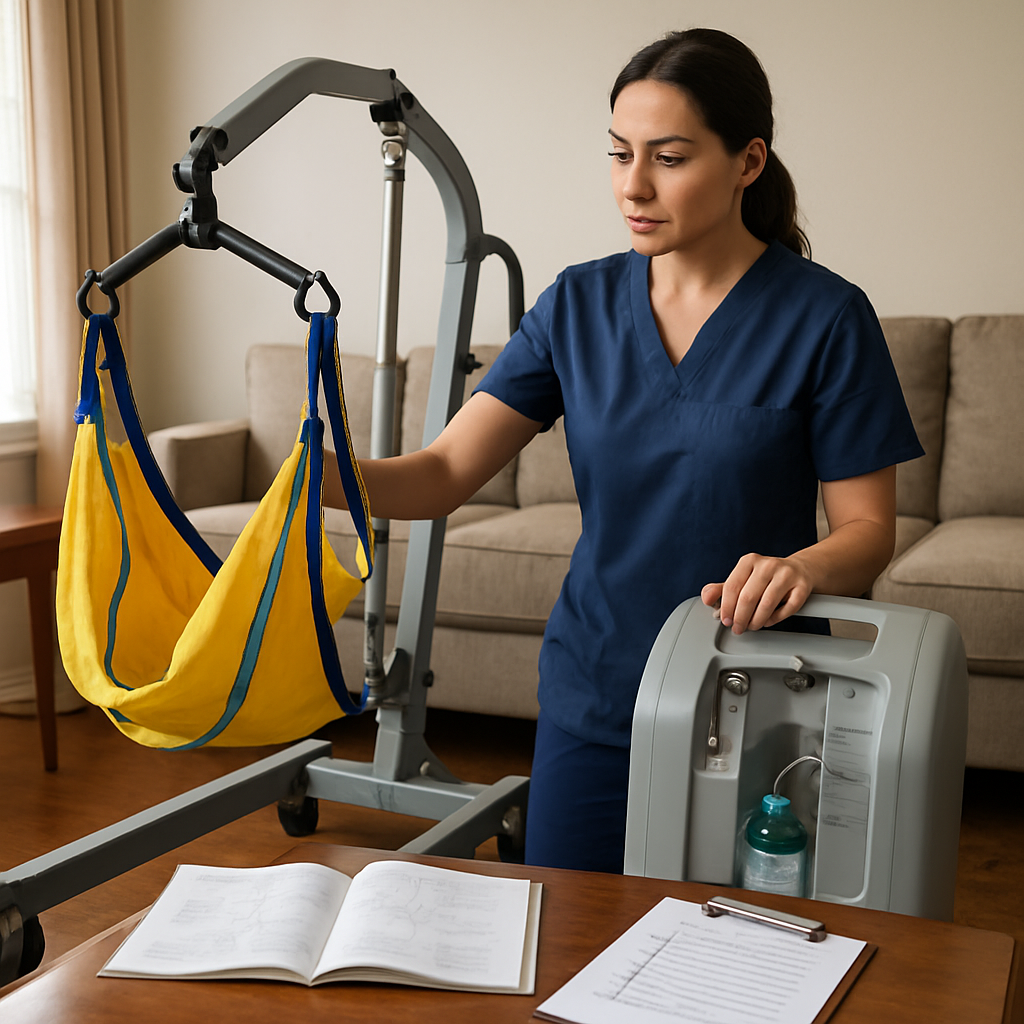
- Equipment sourcing and responsibility: Which items does the agency supply or arrange – hospital bed, hoist, oxygen – who signs for delivery, who services and cleans equipment, and who pays repairs
- Device training: Are caregivers trained and assessed on specific devices such as Hoyer lifts, oxygen concentrators, and infusion pumps – ask for demonstration or competency checklist
- Medication safety: How are medications stored, recorded, and handed over between shifts – ask to see the MAR process and incident reporting for medication errors
- Power outage and backup: What happens if power fails and the client depends on oxygen, suction, or electric beds – who arranges backup power or rapid transfer
- Fall and incident protocol: What is the step-by-step response to a fall, and how is the incident documented and communicated to family and the clinical lead
- Access for emergency services: Is there a lockbox or key protocol so paramedics can enter, and does the agency coordinate with local EMS if necessary
Practical insight: many agencies outsource equipment to third-party vendors. That reduces their capital cost but complicates repairs and liability. Always ask for the vendor name, model numbers, service guarantee, and a signed delivery checklist so responsibility is traceable.
Trade-off to consider: having the agency supply and manage equipment costs more upfront but removes the logistics burden from families and usually shortens setup time after discharge. If you choose private hire, expect to handle rental coordination and maintenance yourself.
Concrete example: A post-operative client needed oxygen at home and a powered hospital bed. The agency arranged the concentrator through a vendor, but the family kept the agency’s delivery receipt and the vendor contact. When the concentrator alarmed at night, the agency dispatched an on-call RPN within 45 minutes because the vendor and agency details were already documented – the response was faster than trying to locate rental paperwork during the emergency.
- Before the first visit: request copies of the equipment inventory, device manuals, and proof of service agreements
- At the in-home assessment: ask the caregiver to demonstrate safe use of key devices and sign a competency checklist
- Confirm communication flow: get the agency on record for who calls family versus who calls 911 and where incident reports are stored
Where to verify standards: for agency-level policies and accreditation look to Accreditation Canada and provincial guidance such as Ontario Health Home and Community Care. Also review the agency’s incident reporting policy and ask how they have handled a recent emergency – specifics matter more than generic statements.
If an agency cannot produce written procedures, vendor contacts, and competency records during your first call, treat that as a red flag and keep searching.
6. Questions to understand costs, billing, and funding including Passport
Direct question to start with: ask for a written fee schedule that spells out base hourly rates, weekend and holiday premiums, minimum visit lengths, cancellation penalties, and any travel or supply charges. Verbal estimates are common but they create disputes; insist on a line item invoice example before you commit.
What to demand on cost transparency
- Get the full price picture: ask whether quoted rates include administration fees, assessment fees, and HST, or whether those appear as extra line items.
- Overtime rules: ask exactly when overtime starts, how it is calculated, and whether sleepover or live-in shifts have separate rules.
- Cancellation and rescheduling: what notice is required to avoid charges, and what happens for missed shifts due to staff illness.
- Billing frequency and format: will you get monthly statements, itemized invoices with caregiver names, and electronic payment options such as e-transfer or credit card.
Trade-off to understand: agencies that bundle services into packages can feel simpler but often hide variable fees that balloon during complex care (extra nursing tasks, wound supplies, or last-minute coverage). Paying a higher clear hourly rate usually gives predictability; packaged discounts can backfire if you need flexibility.
Funding sources: what to ask about Passport and other subsidies
Ask whether the provider is certified to accept Passport funds and what parts of care are eligible. The Passport Program supports adults with developmental disabilities and is not the same as Home and Community Care funding. Confirm whether the agency will bill Passport directly or expect you to manage the transfer and submit receipts. See the official Passport overview at Ontario Passport Program.
Practical limitation: not all home care activities are eligible under every funding source. Expect gaps for specialized nursing tasks, medical equipment rental, or privately contracted skilled services. When in doubt, get the agency to provide a written statement of what they will bill to Passport versus what you will pay out of pocket.
Concrete example: a family arranging respite and personal care for an adult with developmental disability verified that the agency was a Passport vendor. The agency agreed to bill Passport for scheduled PSW visits but required the family to cover weekend premium hours directly. That avoided a surprise monthly bill and clarified who handled receipts for audit.
Employer and tax consequences: if you hire privately instead of through an agency, you become the employer. That means payroll remittance, CPP, EI, and WSIB considerations in Ontario. Many families underestimate this burden; ask for a checklist or talk to a payroll service before choosing private hire.
Next practical step: when you call providers, use the questions above and follow up by sending a short email requesting the written fee schedule and confirmation about Passport vendor status. If they hesitate or give vague answers, treat that as a warning sign and move to the next candidate. For context on service tasks and costs, see Cedar Home Health Care‘s breakdown of home aide services and costs at What to Expect from Home Aide Services: Tasks, Training, and Costs.
7. How to evaluate quality, references, and red flags to watch for
Start with outcomes not promises. Agencies and private caregivers can describe training and policies all day. What matters in practice is whether visits happened as scheduled, clinical issues were escalated promptly, and family members experienced clear communication when problems arose.
What to ask the references you are given
- Ask for references with similar needs. Request three clients who had the same service mix such as post operative wound care, dementia support, or 24 hour home care service.
- Concrete, measurable questions. Ask: how often were visits missed or late in the last month, did they observe medication mistakes, and how quickly did management respond to a concern – within hours or days?
- Probe for negatives. Request one reference who stopped services and ask why – honest answers reveal more than curated praise.
- Verify continuity. Ask whether the same caregiver or small team showed up consistently or whether the household saw rotating staff every week.
Practical limitation to accept. Many agencies will only give you current client references for privacy reasons. If you cannot get direct client names, insist on written case studies or anonymized outcome summaries that show measurable results for similar clients.
Objective checks and red flags to watch for
- Verify regulated credentials. Confirm RN or RPN licence numbers through the College of Nurses of Ontario and ask for documented competencies for PSWs and home health aides.
- Look for accreditation and complaints handling. Accreditation Canada status and a published incident reporting policy are quality signals; see Accreditation Canada for standards.
- Request sample records. Ask to see an anonymized initial assessment, a two week care plan, and one incident report – if an agency refuses, treat that as a red flag.
- Watch for turnover and staffing gaps. High turnover is not just inconvenient. It correlates with missed care, training gaps, and communication breakdowns.
Tradeoff judgement. Small providers can deliver consistent, personalized care but may lack formal reporting systems or backup staff. Larger agencies usually have processes and after hours support but can rotate staff more often. Choose based on which risk your family tolerates more – inconsistency or limited escalation pathways.
Concrete Example: For a recent hip replacement, ask references whether the agency coordinated wound dressing changes with a physiotherapist and whether an RN escalated an infection to the surgeon. If references describe quick escalation and documented wound improvement, that is a strong signal for post operative home care capability.
Red flags to stop the conversation immediately – refusal to provide references, no written care plan, inability to name the clinical lead, pressure to sign a long contract without a trial visit.
Next consideration. After you vet references and objective records, schedule a short trial period and track three metrics – punctuality, documentation quality, and escalation responsiveness – before committing to longer term care.
8. Practical tools: phone script, in-home visit checklist, and decision matrix
Practical tools shorten the guessing game. When you search for home care services near me, a tidy phone script, a focused in-home checklist, and a simple decision matrix let you compare providers on facts instead of impressions. Use these templates as working documents you update during calls and visits.
15-question phone script (use verbatim)
- Identify: I am calling about home care for [client name], can you confirm the agency name and locality?
- Services: Do you provide the specific service I need (PSW visits, RN wound care, palliative support)?
- Clinical oversight: Who is the RN/RPN clinical lead and how often do they review care plans?
- Insurance: Do you carry commercial liability and malpractice insurance?
- Background checks: Are criminal record checks and references mandatory for staff? When were they last updated?
- Accreditation: Are you accredited by Accreditation Canada or another body?
- Staffing/continuity: Can you guarantee a primary caregiver or consistent team? What is your typical turnover?
- On-call: Is clinical staff available 24/7 and what is the response time for urgent calls?
- Costs: What is your written fee schedule and what is billed separately (travel, overtime, equipment)?
- Funding help: Do you assist with Passport, Veterans Affairs, or other funding applications?
- Equipment: Can you supply or coordinate medical equipment and who maintains it?
- Documentation: How do carers record visits and can family access notes?
- Trial: Do you offer a 48 to 72-hour trial and what happens if the trial fails?
- References: Can you provide three recent references with similar needs?
- Contract: Will you provide a written service agreement before starting?
Practical insight: Phone answers are rehearsed. Require written confirmation for key claims—insurance, RN oversight, and sample care plans—before you commit.
10-point in-home visit checklist
- First impressions: Caregiver arrives on time, wears ID, and presents professionally.
- Infection control: Hand hygiene, glove use, and mask practice observed where appropriate.
- Medication handling: Correct meds, packaging, and documentation are explained and shown.
- Clinical competence: RN/PSW demonstrates key tasks you need (wound care, transfers).
- Home safety: Pathways, grab rails, lighting, and fall risks are assessed.
- Equipment condition: Beds, lifts, oxygen concentrators are clean and functional.
- Care plan review: Staff reviews and updates a written, measurable care plan with you.
- Communication style: Staff explains tasks clearly and respects the client.
- Record keeping: Visit notes, incident reporting, and escalation steps are visible.
- Family engagement: Agency explains how family is notified about changes or incidents.
Concrete example: After a hip replacement, a family used this checklist during two agency visits. One agency arrived on time but could not demonstrate safe medication reconciliation; the family stopped the trial and chose the other agency that produced documented medication checks and RN sign-off.
Decision matrix: compare finalists with weighted criteria
| Criteria | Weight (1-5) | Agency A (score x weight) | Agency B (score x weight) | Agency C (score x weight) |
|---|---|---|---|---|
| Clinical capability (RN oversight, wound care) | 5 | 4 x 5 = 20 | 5 x 5 = 25 | 3 x 5 = 15 |
| Continuity (primary caregiver + low turnover) | 4 | 3 x 4 = 12 | 5 x 4 = 20 | 2 x 4 = 8 |
| Costs and billing transparency | 3 | 4 x 3 = 12 | 3 x 3 = 9 | 5 x 3 = 15 |
| Funding assistance (Passport, VA) | 2 | 2 x 2 = 4 | 4 x 2 = 8 | 3 x 2 = 6 |
| References and quality signals | 3 | 5 x 3 = 15 | 4 x 3 = 12 | 2 x 3 = 6 |
Judgment call: Weight clinical capability and continuity higher when risk is high (post-op, palliative). If budget is the main constraint, shift weights toward cost—but accept higher operational risk.
Next step: Use the script on your first call, bring the checklist to every visit, and run the decision matrix with real scores. For Ontario-specific funding or clinical questions, see Ontario Health Home and Community Care and our guide on when to hire a home nurse at When to Hire a Home Nurse.